Infidelity is one of the most painful experiences in life. We remain in that pain for far too long, drowning in anger, rage and hurt. The anxiety we feel cuts with its edge into other areas of our lives too. We become powerless, because we begin to doubt everything that matters to us, everything that, until that moment, was good and worthwhile in our lives. Life turns into mere existing. Anything, just to avoid the image of the person to whom we gave ourselves and promised faithfulness, now in the embrace of another man or woman. In any case, this is a blow that changes life at its very foundations, both for the one who has been unfaithful and for the one who has discovered the infidelity.
What next, and how, after infidelity?
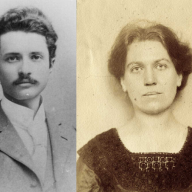
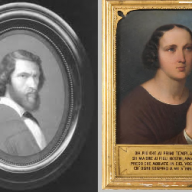
I would like to tell you the story of a marriage marked by the anguish of her husband’s infidelity, the story of Elisabetta Canori Mora, whom Pope St John Paul II beatified in 1994. She lived at the turn of the eighteenth into the nineteenth century in Rome, Italy. From the story of the infidelity of her husband Cristoforo, people today, in a world where statistics show that one in every three couples divorces, can learn how the anguish of conflict-ridden marriages does not necessarily end in divorce or long-term therapy, but can instead be completely transformed into the beauty of God’s presence on earth.
"The good Lord gave me a father and a mother more worthy of heaven than of earth."
St Thérèse
"There was perfect understanding between our parents,
although they were known to differ on certain points of view."
Their daughter Celina
The married couple St Louis Martin (1823 – 1894) and St Marie-Zélie Guérin (1831 – 1877) are the first married couple in the history of the Catholic Church to be canonised together as saints. They are also the first parents of a canonised saint to be beatified. They were not declared saints because they had a saint for a daughter, St Thérèse, but because they themselves lived holy lives.
We are publishing the story of the married couple Ciro Piccolo and Raffaella Esposito Corcione, who are the joint authors of a handbook for young couples on the subject of courtship (Il Manuale del corteggiamento). They give us their testimony about the beauty and depth of their relationship with one another, and how the use of natural methods can be a great help in marriage. This is knowledge that every woman and every man should possess!Janet Smith says: "The fact that couples who use natural family planning almost never divorce reveals a great deal. Natural family planning is much more than abstinence. It is a method that requires a great deal of communication and shared values."
A few days ago marked the 75th anniversary of the dropping of the atomic bombs on Hiroshima and Nagasaki. In this article we bring the marriage and family story of Paul Nagai Takashi and Midori Moriyama, of his conversion, and of their shared witness to family and marital devotion, Christian love and commitment to peace.
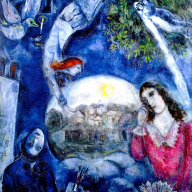
A Story of Marriage and Love in Pictures: Marc Chagall and Bella Rosenfeld
And you became my wife
For the years to come. Dearest.
You gave me our daughter, a rare gift
on the most solemn day...
Thank you, O God on high
For the day and for the month.
Marc Chagall
He portrays his wife as an imaginative, intellectual, assertive woman: "With whom can I compare her? She was like no other. She was Bashenka-Belochka on the hill, reflected in the river Dvina with its clouds, trees and houses. I wanted to wake up inside my own daydream." Her voice was, as he put it, "like the song of a bird from another world."
Two revolutions, two wars, poverty, frequent travels — Bella Rosenfeld, Marc Chagall's faithful muse and wife, was with him for almost 30 years. His angel, the symbol of love in all his paintings, gentle, clever, beautiful, Bella understood Chagall as no one else did and accepted him just as he was. Not a single painting was finished without her approval; the artist adored her, loved her as he loved no one else, to the end of his long life.
The composer Ennio Morricone, who during his lifetime created famous and wonderful melodies, died on 6 July 2020. He was born on 10 November 1928 in Rome, where he spent his entire life.
His wife Maria Travia was born in 1932 in San Giorgio di Gioiosa Marea (Messina-Sicily), on the last night of the year, 31 December. However, as early as 1933 her family moved to Rome, where Maria grew up. She was a friend of Adriana, Ennio's sister.
Shortly before his death, he named her in writing as the one to whom he had entrusted everything: "Last, but not least, Maria. With this I renew the extraordinary love that has held us together, and I am not glad that I must leave her. The most painful thing is to say goodbye to her."
It is somewhat surprising that Christian Zadar has no home-grown saints of its own, and that the saints venerated in our city — Anastasia, Chrysogonus and the elder Simeon — were all brought here from elsewhere. The only one recognised by the Church as a blessed is James of Zadar, and even he won his renown and died in Italy, at Bitetto near Bari. So we must admit that we are, in a sense, poor in officially canonised saints. Yet when we come to eternity, we shall see that throughout the long Christian history of Zadar there lived a great many holy people who can be models and intercessors for us. One of them is Anđelika Salghetti-Drioli, née Isola, a holy woman and mother, together with her husband Frane.
"Friendship between husband and wife seems to exist by nature; for man is by nature more inclined to pair with a mate than to associate with a fellow citizen, inasmuch as the household is an earlier and more necessary thing than the state.".
"He who is unable to live in society, or who has no need because he is sufficient for himself, must be either a beast or a god."
Aristotle
Martin Buber asserts: "In the beginning is relation." Relation (Beziehnung) leads us to encounter (Begegnung).
"God is our refuge and strength, a very present help in trouble. Therefore, let us not fear though the earth should shake, though the mountains fall into the heart of the sea. Though the waters of the sea roar and rage, though the mountains tremble at their fury: Yahweh of Hosts is with us, our refuge is the God of Jacob!" (Ps 46:2-4)
"He was always my comfort (counsellor) and support."
The last words Zélie wrote to her husband were: "I am entirely yours."
St Zélie
"I feel that our family, modest though it is,
is honoured in that our wonderful Creator has numbered it among his favoured ones."
St Louis
The Martin family lived their lives following the liturgical feasts. On working days the parents began with Holy Mass at half past five in the morning. Mr Martin's influence extended to a whole circle of friends. Many of them, without Louis, would probably have given themselves over only to worldly amusements. He drew them to frequent Catholic circles, kindled their enthusiasm for the feast-day customs of the parish and for visiting the sick. They were not turned in upon themselves, but were, instead, attentive to what was happening around them.
The Bible begins with a garden, a garden that God planted in Eden (cf. Gen 2:8), and it ends with the mention of a garden-city, the heavenly Jerusalem: "through the middle of the street of the city; also, on either side of the river, the tree of life with its twelve kinds of fruit, yielding its fruit each month; and the leaves of the tree were for the healing of the nations" (Rev 22:2). At the very centre of the Bible, too, there is a garden, the one in the Song of Songs, of which Rabbi Akiva said that it was the "Holy of Holies" of Scripture; a garden with flowing waters and trees in bloom.
We would like to reflect on this twofold perspective, which links the "mystery" of the garden with that of the human couple. Why does the couple arrange to meet in a garden? How does the anthropological and cosmic figure of the couple in the garden bear a theological truth? The Song of Songs will provide the "setting" for this reflection; it is on its pages that the lovers' invitation to go to the garden is expressed most explicitly: "Let my beloved come to his garden [...]. I come to my garden, my sister, my bride" (Song 4:16-5:1). We will speak of the web of shared roots, of care for a shared home, of love within the family. The couple, considered in this context, opens itself to the divine plan, to life in its fullness, with fruit of many kinds.
Our marriage was ideal. If that could be turned into an advertisement, I would say: "Live your marriage the way Cvijeta and I did!" She was the happiness of my life. Please do not take that as a banal thing to say.
Boredom has always been a foreign and unknown word in our life.
Besides sightseeing in cities, we were drawn to places of silence.
Two days ago, at the age of 94, academician Viktor Žmegač died – a special man: gentle, calm, reliable, precise. Like a Renaissance man, he knew a great deal, and too much, about facts, events, people, countries, art, life. He is kind. Strict, even with himself. A Germanist and Croatist, professor emeritus at the Faculty of Humanities and Social Sciences in Zagreb, a writer, historian, musicologist, theorist of literature and art, and travel writer.
In the last fifteen years or so, Professor Žmegač wrote about a dozen phenomenal books on the civilisation, culture and art of Europe. Above all, he loves the culture and art of Europe, which he considers the centre of our planet. He is erudite. Top-class. That is him: someone who has a deep knowledge of whatever he engages with or studies.
He was married to Cvijeta, the author of German-language textbooks and an outstanding teacher in language schools: "I loved her immeasurably, from the very first day until her death. We lived for half a century in a happy marriage. The years that followed, right to the end, were the only tragedy of my life. She had to live in a care home, in an ever-worsening state. She was struck by an incurable, slow-progressing illness. There is no treatment. Even today, not a single day goes by without my remembering episodes from our marriage. She was not only beautiful, dear, and devoted to the family; she was also tremendously witty, full of jokes and quips. Our marriage was ideal. If that could be turned into an advertisement, I would say: "Live your marriage the way Cvijeta and I did!" She was the happiness of my life. Please do not take that as a banal thing to say.
My husband! My husband! My husband! Dry, you see, are my eyes, yet I do not wish to hide my love.
Begging you, forgive me: never again, moved with feeling, on your return from battle shall I be able to embrace you.
I am ready for death/ nor do I fear it when the executioner swings his sword, I shall hold myself with pride, as a nobleman and a Croat.
Grieve not at all/ Let me be a woman, let me wail, let me moan, let me tear my own heart apart.
Mate Marčinko
The wedding of Ana Katarina Frankopan and Petar Zrinski took place in Karlovac, with the celebration held in Ozalj on 27 October 1641. It united the most powerful Croatian noble families, the Zrinski and the Frankopan. They had four children: Jelena, Judita Petronila, Ivan Antun Baltazar and Aurora Veronika.
Katarina married Petar at the age of 16, and from then on lived with her husband in Ozalj, occasionally also visiting Čakovec, to which she would move with her husband after the tragic death of his brother, the Croatian ban Nikola Zrinski. She also stayed from time to time at other Zrinski and Frankopan estates – in Vrbovec, on Grobnik, in Kraljevica and in Novi Bribir. All these estates were not merely working farms but also centres of public and cultural life, where Croatian was spoken, in the Kajkavian, Čakavian and Štokavian dialects alike, where people wrote and debated world and national affairs, and where literature, art and culture were cultivated.
We present the marital, family and patriotic story of Petar and Katarina Zrinski, and his farewell letter to his beloved wife before his execution.
"But their eyes were kept from recognising him" (Lk 24:16)
Recently, in a care home in England, the carers brought an unusual birthday gift for a 94-year-old widower. A small pillow. The pillow the carers had given him bore a picture of his late wife. Herecognised her.
And the LORD God said: "It is not good that the man should be alone; I will make him a helper fit for him."(Gen 2:18)
This sentence of God introduces us to the biblical world of couples. Why does God say that solitude is not good? Because in solitude we cannot love or be loved. From the very beginning, from the creation of the world, we observe God's wonderful design. God wants man to exist in this world as male and female. This mysterious difference between man and woman is immeasurably dear to him.
"For I am sure that neither death nor life, nor angels nor principalities, nor things present nor things to come, nor powers, nor height nor depth, nor anything else in all creation, will be able to separate us from the love of God in Christ Jesus our Lord" (Rom 8:38-39)
In 1842, the 33-year-old colonel of the Dutch cavalry Jacobus Warnerus Constantinus van Gorkum (1809-1880) married a 22-year-old woman of noble rank, Jonkvrouwe Josephina Carolina Petronella Hubertina van Aefferden (1820-1888). The marriage was highly controversial, not primarily because of their difference in rank, but chiefly because of the difference in their religion - van Gorkum was a Protestant, and van Aefferden was a Catholic. The two communities lived in great mutual hostility. The two of them fell in love, but their wish to marry met with great resistance because of differences in faith, status, wealth, political allegiance and origin. Despite these objections, they married in 1842 and enjoyed a happy marriage for almost thirty-eight years. The marriage was blessed with three children: two sons and a daughter. Josephina remained a Catholic, Jacobus remained a Protestant, and the couple somehow managed to defy the intense hostility from both sides, until death parted them - for a time.
it sank into the great flower, adorned with leaves so many,
and thence reascended to where its love abideth evermore.
Their faces had they all of living flame...
because the light divine so penetrates
the universe, according to its merit,
that naught can be an obstacle against it.
This realm secure and full of gladsomeness,
crowded with ancient people and with modern,
unto one mark had all its look and love.
O Trinal Light,
that in a single star, sparkling upon their sight, so satisfies them,
look down upon our tempest here below!
Dante, Paradiso, Canto XXXI
How is marriage possible, if this will — my own, wilful, stubborn, proud will (I don't mean just Filip or Karla, but all of us) — if this will of ours, this idolatry of ours, does not submit to the heavenly will, to God's will… That is why we say that Christian marriage is a marriage of three: husband, wife, and Jesus Christ. He is listened to. He is the head. It submits to the Father's will.
Homily by Don Antun Nižetić, Cathedral of St Anastasia, Zadar, 13 May 2023.
Continuing our series of texts on biblical couples, we find ourselves facing a real challenge. Next in line is Noah, the tenth biblical patriarch after Adam. However, the aim - and at the same time the challenge - of this text is to get to know Noah's life companion. Let us take things in order.
"Marriage is like the tango - each person dances in their own way, and it all looks perfectly in step"
While we are forced to be by one another's side more than usual, conflicts don't knock at the door - they barge in uninvited. Perhaps now is the right time to "welcome" them, to sit them down at the table with us, and finally set some rules of conduct to protect ourselves from their destructive intrusion into our lives.
In the Bible, family and marital disputes are almost identical to our own times. Even then, the patterns of marital behaviour in disputes were already very topical and well known. These patterns can be summarised according to the following types of behaviour of marriage partners:
- 'shifting the blame onto the other spouse' ('it's not me, it's...')
- 'outbursts of jealousy' ('where were you?')
- 'children as a source of marital problems' ('never anything from him/her'')
- 'infertility of husband or wife' ('we're left on our own')
- 'macho man and good woman' ('wise woman and foolish husband').
We shall find all this, and more, in the marital stories of today. We have chosen several characteristic biblical stories of marital disputes which have left a deep mark on the biblical narrative and on history, that is, several biblical married couples together with a kind of 'motto' of the disputes that ran through their conflicts: Adam and Eve ('it wasn't me'); Sarah and Abraham ('we are left alone'); Isaac and Rebekah ('big children, big worries'); Rachel and Jacob ('I have had enough of everything'); Nabal and Abigail ('beauty and the fool').