Love One Another as Companions on the Road
Alessandro Manzoni
The Betrothed (I promessi sposi)
What a story of love! Love as a virtue struggles against folly and corruption, betrayal and hypocrisy, against cowardice and vicious brutality, against rebellion and disease — and wins.
Lombardy is the place upon which fell all the misfortune and depravity embodied by the four horsemen of the Book of Revelation: war, famine, plague, death. All four pass through Lombardy and lay the land waste.
The plague, brought as patient zero by an Italian soldier in the service of hostile Spain, indeed strikes all the significant characters, and most will as a result find themselves in quarantine. Everyone comes to understand the plague as something more than a disease, for the sickness radically changes or redefines what they had imagined to be their fate. They understand it as a higher power, a scourge that cleansed the land of wicked men, embodied by the "bravi". It touched everyone and everything — "no one trusted a friend, a neighbour, a relative". Its hidden poison lay in the most intimate relationships and places; everyone was suspect, no one was safe, every meeting and every touch could mean death.
Amid such circumstances, two young people, Renzo and Lucia, wish to marry. The obstacle to their marriage is Don Rodrigo, who threatens the priest Don Abbondio with death should he marry them. Don Abbondio, cowardly, yields to Don Rodrigo's threats; Don Rodrigo, for his part, commits every kind of injustice, and his wickedness knows no bounds. He seems almost to have no physical presence at all — he is embodied by his isolated castle, living cut off from everyone, alone with his deep fears. Don Abbondio rarely displays what his name suggests — the "abundance of divine grace and of moral and spiritual gifts" his office requires; he lives in constant fear for his own life, and because of that fear he can devote himself neither to God nor to his neighbour: "Oh, wretched me! What people! What hearts! There is no love, everyone thinks only of himself, and no one thinks of me." After these words he buries in the garden what money he has left.
The two young betrothed flee — Renzo to Milan, and Lucia to the convent at Monza. Rodrigo persists in his pursuit of Lucia and arranges her abduction from the convent, aided by the Innominato — "the Unnamed", without a name because he embodies evil itself. After his conversion, he will be as great in doing good as he was in evil, becoming an "instrument of salvation (strumento di salvezza)" for others. Lucia's words ring in his head: "God forgives a multitude of sins for the sake of one act of mercy", and his conversion happens symbolically at dawn, with the rising sun, a liberating weeping of repentance, and the arrival of the cardinal, who receives him as a lost son.
Lucia is helped by the Capuchin Fra Cristoforo, whose name means "the one who bears Christ" — across a swollen river full of mortal dangers. Selflessly, like Christ, he serves others, standing against every kind of injustice and laying down his life for others. In Lucia he recognises goodness and purity of soul, and in Renzo, sincerity and selflessness. He tells Lucia that God himself has come to her in protection: "God has indeed visited you (Dio vi ha visitate)".
Lucia Mondella, whose name means "light of the world", is she who embodies goodness and innocence, which have the power to overcome those seized by great evil (the Innominato), and which light up the darkness of the world. She is the one through whom true miracles come about — (la giovine del miracolo), always following the path of goodness without knowing what awaits beyond it.
Renzo Tramaglino, whose name means "one who receives the victor's wreath", who always finds a way out of the countless snares in which he is caught (tramaglio is a kind of net). What Lucia possessed as a gift, Renzo had to earn through various trials and works of mercy, and it all culminates in the act of forgiving Rodrigo.
Renzo and Lucia both fall ill with the plague, he in Bergamo (then under Venetian rule) and she in Milan, ravaged by plague and other misfortunes (then under Spanish administration), but both will survive. Fra Cristoforo, who has himself fallen ill with the plague, before he dies asks Renzo to give up his demand for justice and to forgive Rodrigo, who caused them so much suffering and evil. For only in the act of forgiving, not in punishment, lies the resolution (risolvimento) that will restore Lucia to him.
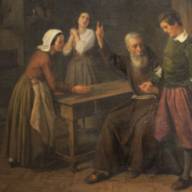
"Listen!" said Fra Cristoforo to Renzo in a low, deep voice — "It can be a punishment, it can be a mercy. The feeling you now have toward this man who wronged you — yes, God feels that very same thing when you wrong him, and one day you will find yourself in that same position before him. Bless him (Rodrigo) and you will be blessed. Perhaps this man's salvation, and your own, depends on you, on your capacity for forgiveness, for compassion ... for love!"
Fra Cristoforo commits his enemy to God's justice: "A day will come (Verrà un giorno)" when he will render account to God. Don Rodrigo dies in agony in the Milan lazaretto, alone and abandoned, despite Renzo and Lucia having forgiven him. Don Abbondio nonetheless manages to survive the plague. Reflecting on the effect of the plague, which freed Lombardy of Don Rodrigo and his men, he remarks: "Ah! … If the plague always and everywhere did such things, it would be a shame to speak only ill of it. One might say it is needed by every generation", alluding to Rodrigo's death. In the end, under pressure from Cardinal Borromeo (protector of the poor and the lowly), he takes part first in saving Lucia, and then in the marriage of the two young people.
Before he dies, Fra Cristoforo counsels Renzo, leaving him a kind of testament: "Go with good intent. God will surely bless your perseverance in finding her, and your love for her, your faithfulness in wanting and seeking the one God gave you — God, who is stricter than man, but who in his forgiveness will not dwell on what is imperfect in the way you seek her. Remember that we are answerable for our actions, not before men, but, without any doubt, before God."
"Remember, my son, that if the Church gives you this companion, she does not do it to give you a temporal and earthly comfort which, however great, would have to end in great sorrow at the moment of parting. She does it to set you both on the road of a comfort that never ends. Love one another as companions on the road, with the thought that one day you will have to leave one another, but with the hope of being together again forever." If God grants you children, take care to raise them, to instil in them love for Him and for all people. And so you will guide them well in everything else. They will live in a sad world and in sad times, among proud and provoking people. Just tell them always to forgive, always! Everything, everything!"
At last, Renzo finds Lucia in the lazaretto. They will soon marry and begin a new family life.
- Mladen Klanac
- Hits: 51