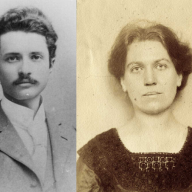
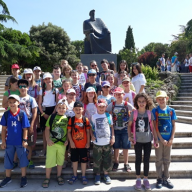
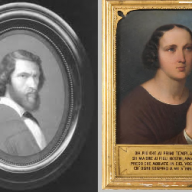
According to God’s providence, at the beginning of the twentieth century, in the year 1920, the Congregation of the Daughters of Mercy, Third Order Regular of St Francis, was established in Blato na Korčuli. In establishing it, the good Lord made use of Miss Marija Petković-Kovač, daughter of the late Antun from Blato on the island of Korčula, and of the then Bishop of Dubrovnik, Dr Josip Marčelić. Thus Marija of the Crucified Petković – both in her homeland and throughout the world, together with her Congregation – became all things to all people in life-giving goodness, bearing witness to Christ’s presence in the world until he comes. She founded and set in motion her small community so that it might do good among the most vulnerable, and so that this community might become a sower and witness of good in this joyless world, this true valley of tears.
Marija had exemplary parents, and she loved her father in particular, whom she regarded as a "living saint". In childhood, surrounded by his love and by the good Christian upbringing of her mother, within a family atmosphere that the Second Vatican Council, some sixty years later, would call a "domestic Church", Marija showed an unusual piety and inclination towards meditation, yet she also happily kept company with the poorest girls from the neighbourhood and secretly helped them.
I confess that the two of us are struggling against one another.
The two of us were so different, and in that difference so dangerous to one another.
I needed a little encouragement, a little kindness, to open the way for me, and instead you blocked it for me, with good intentions, of course.
In Letter to His Father Franz Kafka recounts, in the form of a letter, a life fundamentally marked by disputes and misunderstanding with his father. The letter was meant to show everything that had gone wrong between them, since they could no longer talk to one another. He wrote this letter in 1919, when he was 36 years old, but he never handed it to his father. The occasion for the Letter was his father's question as to why Franz was so afraid of him: "You asked me recently why I maintain that I feel fear in your presence. As usual, I did not know how to answer you, partly for the very reason that this same fear is what I feel in your presence." Fear so overpowered him that it turned into a feeling of guilt: "In your presence I lost my self-confidence and exchanged it for a boundless sense of guilt." In this situation Franz feels weak and powerless, unprotected. He always feels guilty, because he can never be in the right: "No one else was allowed to gnaw the bones, only you. No one else was allowed to slurp vinegar, only you." He became an insecure child, and that insecurity opened the door to further fears.
In the monastery of the Discalced Carmelite nuns in Đakovačka Breznica I was leading a novena to St Joseph, where I saw this image of St Joseph with Jesus sleeping on his chest. I had never before seen a depiction that radiates so much love and tenderness between Jesus and Joseph. I was so moved by this image that I went looking for it on the internet, and found that the original icon is kept in the chapel of a religious community in Spain. Anyone who wants more information can visit the website: https://www.hogardelamadre.org/es/.
When we contemplate a sacred image, dwell on its content and enter into the scenes it depicts, we are in fact meditating, and meditation is prayer. We shall meditate on the life of St Joseph, whose life is inseparable from the life of the Most Holy Trinity itself, and from the life of Jesus and Mary. That means we shall be with God and with the Holy Family.
My father always treated everyone the same, whether that was the queen or the street sweeper and he really believed that all human beings were equal. I apply that same value to everything that I do in my life.
My father was a man of courage and vision.
He really believed in the power of unity and that if people all over the world came together, they would strike a blow to any form of injustice.
He was truly authentic to what he believed in and there were core values that formed his life: humility, perseverance, honesty and forgiveness.
Almost a decade since his death on 5 December 2013, Nelson Mandela continues to inspire millions of people throughout the world in their non-violent commitment against every form of racism. Still today, the Nobel Peace Prize laureate is a reference point well beyond the borders of South Africa.
Among those who walk in the footsteps of the South African leader, is his daughter, Makaziwe Mandela, who is involved with various charitable works and is the founder and president of “House of Mandela”, a company that through clothing — especially for young people — carries on the anti-racist message of her father.