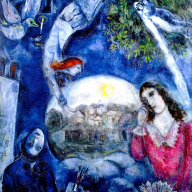
I Could Walk in My Garden Forever
I sought him whom my soul loves
I come to my garden, my sister, my bride
There I will give you my love
I found him whom my soul loves
I held him, and would not let him go
The Bible begins with a garden, a garden that God planted in Eden (cf. Gen 2:8), and it ends with the mention of a garden-city, the heavenly Jerusalem: "through the middle of the street of the city; also, on either side of the river, the tree of life with its twelve kinds of fruit, yielding its fruit each month; and the leaves of the tree were for the healing of the nations" (Rev 22:2). At the very centre of the Bible, too, there is a garden, the one in the Song of Songs, of which Rabbi Akiva said that it was the "Holy of Holies" of Scripture; a garden with flowing waters and trees in bloom.
We would like to reflect on this twofold perspective, which links the "mystery" of the garden with that of the human couple. Why does the couple arrange to meet in a garden? How does the anthropological and cosmic figure of the couple in the garden bear a theological truth? The Song of Songs will provide the "setting" for this reflection; it is on its pages that the lovers' invitation to go to the garden is expressed most explicitly: "Let my beloved come to his garden [...]. I come to my garden, my sister, my bride" (Song 4:16-5:1). We will speak of the web of shared roots, of care for a shared home, of love within the family. The couple, considered in this context, opens itself to the divine plan, to life in its fullness, with fruit of many kinds.
The phenomenon just described is repeated with regard to the human couple, to the betrothed, to husband and wife. On its opening pages the Bible tells of the appearance of the human couple (cf. Gen 2-3), and in its final lines we hear the cry of the bride to the bridegroom, of the Church to Christ who comes in his glory: "The Spirit and the Bride say, Come" (Rev 22:17). But the Bible also lets us hear the crossing voices of the beloved woman and the beloved man even at the very centre of its corpus, in that sanctuary which is the Song of Songs: "Behold, you are beautiful, my love"; "Behold, you are beautiful, my beloved" (Song 1:15-16).
In the book of Genesis the human couple appears in a garden that God planted, but entrusted to man (cf. Gen 2:8). This garden (in Hebrew, gan) is an "enclosure" (the root ganan means "to enclose, to protect"), watered by four rivers, and abounding in every kind of plant: "the Lord God made to grow every tree that is pleasant to the sight and good for food, the tree of life also in the midst of the garden, and the tree of the knowledge of good and evil" (Gen 2:9). In this microcosm of creation, man and woman discover one another, at first filled with the gifts of their origin.
Although the human couple was banished from this garden because they transgressed the divine commandment, the garden nonetheless does not disappear from the biblical horizon: it reappears again and again in the biblical poets and prophets. The metaphor of the garden appears, for instance, in Isaiah 61:11, in an announcement to a grieving people of the certainty of a divine intervention in their favour: "For as the earth brings forth its shoots, and as a garden causes what is sown in it to spring up, so the Lord God will cause righteousness and praise to spring forth before all the nations." It points to the transformation Israel will undergo after God's intervention: "you shall be like a watered garden, like a spring of water, whose waters fail not" (Is 58:11). In Jeremiah 31:12 the same image is linked to the return from places found in the wilderness. Images from the plant world best express the ontological depth of divine healing: "I will be as the dew to Israel; he shall blossom as the lily, he shall strike root as the poplar; his shoots shall spread out; his beauty shall be like the olive, and his fragrance like Lebanon" (Hos 14:5-6). The metaphor of the garden – linked to other images from the plant world – underlies the biblical vision, showing that the world and its history are always in a state of "becoming", whatever wounds they may repeatedly suffer. God is the one who reactivates this rebirth in the healings he grants: he is the "dew", the mysterious principle of plant life (Hos 14:5; cf. Gen 27:28; Deut 33:13; Ps 133:3).
Whatever the exile from the first garden may have been, the Song of Songs reminds us in particular that the garden is, again and again, the place where the human couple appears. Not so as to repeat the unhappy choice made by the first couple, but so as to experience new beginnings and a new fidelity. In the Song the garden resembles the gardens of the Mediterranean, as well as those of ancient Israel. But the "reality" of the garden in this Book is inseparable from its discourse of love and poetry. The metaphors the lovers introduce in the Song of Songs have the effect of "erasing boundaries". As in Lewis Carroll's novel, the characters pass "through the looking-glass", and in this way open up new worlds to the Song's protagonists, worlds that call for a fitting response. This is the case with the metaphors borrowed from the plant world: [She:] "As an apple tree among the trees of the wood, so is my beloved among young men. With great delight I sat in his shadow, and his fruit was sweet to my taste" (Song 2:3). It is not enough for the bride to see her beloved as an apple tree; she must act accordingly: sit in his shade and eat his fruit. Elsewhere, the bride will plead: "Sustain me with raisins, refresh me with apples" (2:5). And the beloved will say of his bride: "You are stately as a palm tree, and your breasts are like its clusters. I say I will climb the palm tree and lay hold of its branches" (Song 7:7-8). It is not enough to compare the figure of the beloved to a palm tree: one must climb the tree and gather its fruit. The whole paradox of the Song's poetic discourse lies there, in this way of letting go, of being caught up in the play of love, recalling its artistry ("Your stature is comparable to a palm tree").
The bride becomes a garden: she is to be treated as a garden of luscious fruit. [He:] "A garden locked is my sister, my bride" (4:12). [She:] "I am a fountain that waters gardens [...]. Let my beloved come to his garden and eat its choicest fruits" (4:15-16). [He:] "I come to my garden, my sister, my bride" (5:1). [She:] "My beloved has gone down to his garden, to the beds of spices, to pasture his flock in the gardens, and to gather lilies" (6:2). The beauty of the garden metaphor lies in the fact that it is, at once, a revelation of the being of the beloved woman ("You are a garden") and a "map" for the beloved's action, suggesting the fitting response ("to come", "to go down", "to eat"). Both become a garden for the other, and act accordingly.
When the word "garden" appears on the beloved's lips in the Song, it is to express the hidden intimacy of his bride: "A garden locked is my sister, my bride, a garden locked, a fountain sealed" (4:12). If the garden is enclosed, a hortus conclusus, then it is a locked garden, protecting a secret spring, an enclosure within an enclosure. The context signals to us the sexual meaning of this woman's being "locked". In the deepest part of the beloved there appears a mystery, a secret (a spring, a fountain) that is the source of her beauty. It is the bridegroom who develops this discourse, declaring inviolable the sanctuary that the beloved woman represents. He makes himself the poet who sings of her – and thereby her guardian – thanks to the metaphor of the garden: in this case, the "locked garden", in its most secret "chambers", where discreet, lively water sings.
The bride's response is surprising. Taking up the images of the beloved's speech, she brings us an unexpected dynamic. Beyond its walls and hedges, the garden is also an open place: the hortus conclusus is, in the words of Rob Aben and Saskia de Wit, a room with no ceiling. Winds (from the north and from the south) pass through it, coming from somewhere else, breathing into it like a deep breath; waters flow or murmur: "a garden fountain, a well of living water, and flowing streams from Lebanon. Awake, O north wind, and come, O south wind! Blow upon my garden, let its fragrance be wafted abroad" (4:15-16).
The bridegroom will answer, saying: "I come to my garden, my sister, my bride" (Song 5:1). If it is a matter of a "locked garden", the woman is not, for that reason, shut in upon herself; she too breathes in the open air. It is, at once, a closed and an open place: open to the changing sky, to the weather, to the currents of water that pass through it. In its contrasting aspects, the garden thus offers lovers a parable of their being in relationship, between the enclosure of personal mystery and openness towards the other within the bond.
In the Song of Songs, the garden – the orchard or the vineyard – is the place of a wonder that demands the lovers' full attention: "let us see whether the vines have budded, whether the grape blossoms have opened and the pomegranates are in bloom. There I will give you my love!" (7:12). The wonder of spring blossoming is mentioned three times (besides 7:12, cf. 2:13 and 6:11, "the garden of nuts"): the lovers have an appointed rendezvous with the wonder of budding. In the blossoming of the trees in the garden they recognise the blossoming of their own love; the same budding is at work in the natural world and in the union of two people. Modern botany will continue the lovers' discourse, speaking of the sexual nature of flowers, between pistil and stamen; the lovers' intuition, that they belong to one another, is, in a certain sense, unassailable and needs nothing further. Before a vineyard or a pomegranate tree in bloom, the intimacy of the couple is revealed to us in harmony with the whole of creation; the betrothed, for their part, celebrate the flowering of their love. The garden in spring thus offers the wonder of a beginning, at which the lovers marvel: the irresistible gratuitousness of the buds is the very bond of their love.
The garden of the betrothed is made up of more than buds alone: there is also ripe fruit (1:3; 4:13,16; 7:9,14) as well as older trees (6:11; 7:8-9; 8:5). Although love is always at its beginning, it is at the same time enduring (cf. 8:6-7). That is why it is also at home in the garden. The philosopher Robert Harrison likes to say that gardens are places that slow down time. Growth has a slowed rhythm: the ripening of fruit, the growth of trees. The garden, with its long temporality, thus sustains the promises by which lovers live. As a character in Richard Powers's novel The Overstory observes, if lovers carve their names into the trunks of great trees, it is because, in their confusion, they sense the long lifespan of these silent companions of theirs: "Perhaps we hurt the trees that way because they live so much longer than we do." In his own mystical version, the Persian poet Rumi (1207-73) protected the trunk itself, so to speak, when he wrote: "Love is a tree whose branches reach into eternity and whose roots grow into eternity, so that the trunk is nowhere to be found!" Whatever became of the trunk, the promises of the betrothed in the Song of Songs graft themselves onto the trees that surround them (fig trees, cedars, walnut trees), borrowing something of their long life.
The bond that unites the couple and the garden in the Song of Songs receives a surprising Christological transposition in the Gospel of John. In the appearance scene of John 20, the risen Christ and Mary Magdalene take on the roles of the bridegroom and the bride from the Song of Songs. The meeting of the betrothed in the sanctuary of the garden thus proves to be, in this way, at its most evangelical. The scene in John 20 has as its setting a garden, the garden of Jesus's tomb: "Now in the place where he was crucified there was a garden, and in the garden a new tomb where no one had ever been laid. So [...] they laid Jesus there" (Jn 19:41-42).
It is towards that very garden that Mary Magdalene hurries, on the first day of the week, "early, while it was still dark" (Jn 20:1). The discovery of the empty tomb fills her with dismay. To the angels who ask her, "Woman, why are you weeping?", she answers: "They have taken away my Lord, and I do not know where they have laid him" (v. 13). Then she turns and sees Jesus, who in turn asks her: "Woman, why are you weeping? Whom do you seek?" Supposing him to be the gardener, she says to him: "Sir, if you have carried him away, tell me where you have laid him, and I will take him away" (v. 15).
Anyone well acquainted with the Song of Songs will recognise here the scene of the search for the beloved in chapter 3: "Upon my bed by night I sought him whom my soul loves; I sought him, but found him not. I will rise now and go about the city, in the streets and in the squares; I will seek him whom my soul loves. I sought him, but found him not. The watchmen found me, as they went about in the city: 'Have you seen him whom my soul loves?' Scarcely had I passed them, when I found him whom my soul loves. I held him, and would not let him go" (Song 3:1-4). The encounter between the Risen One and Mary Magdalene is thus "dramatised" by means of a scenario borrowed from the Song of Songs. It was in a garden that man lost access to life, and it is in a garden that he finds it again. But what is most remarkable is that this Easter scene in the garden integrates a dialogue between a man and a woman. God's work par excellence – the resurrection of Jesus Christ – finds its fulfilment when it takes up the anthropological symbolism of the words exchanged between a man and a woman, in an enclosed garden.
We live in a time between the garden of the beginning and the garden of the resurrection, while we await the heavenly Jerusalem with its wondrous garden. Over the centuries, the garden of the Song of Songs became, in Christian interpretation, the garden of the encounter between God and man in a mystical marriage, but also in the incarnation of the Word: "Christ therefore came down into his garden," writes Apponius, the fifth-century Italian monk, "laying aside the divine power by which he is united to the Father, so that human weakness might receive him, by which he is united to man, who has become the mediator between the one and the other." To plant a garden means to bring back to life the source, the means and the goal of God's plan in his relationship with mankind; in particular, it means bringing back to life the bond that unites the betrothed couple, husband and wife, and the garden. Between man and woman, the garden is the "Holy of Holies" of reunion, a parable of wondrous beginnings and faithful growth, of secret intimacy and communion with the whole of creation and with its Creator.
To enter a garden and sit down is to enter a place where a person is born to himself – a locus amoenus, dear to Plato and to Erasmus – where a person can think, rest, and pause, because he is close to his own being. "We must cultivate our garden," Voltaire has Candide say. The idea of the garden will always belong, in a privileged way, to couples and to lovers: "Come into the garden, Maud!" is the invitation addressed to his beloved by Alfred Tennyson (1809-92), who also, thinking of his beloved, says that he could walk in his garden for ever.
Taken and adapted from: La Civiltà Cattolica
- Mladen Klanac
- Hits: 64