Do You Love Me?
They say that Mozart would often put a question to those who pressed him to play something for them: Lieben Sie mich? (Do you love me?). If he received an affirmative answer, he would sit down at the piano and display his virtuosity. He could not bear that someone should love his music and his playing without loving him. Love inspired him. It instilled in him security and wholeness, a higher mathematics.
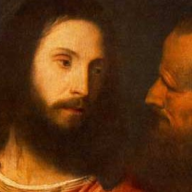
Interestingly, Christ too asked Peter: Do you love me? He wanted Peter to set aside everything that was not His own Person, and to love Him personally. Only this has full meaning. Everything else creates confusion. A person seeks a person!
This question of Mozart's, and of Christ's, puts us in crisis. I always have a tendency to use a person for the sake of some thing. And in just the same way, I am constantly fighting against those who treat me as a thing. This question circles round every person like a halo. Kahlil Gibran put these words into Jesus' mouth, addressed to Mary Magdalene: Other men love themselves in your nearness. I love you in your self. So, when I love something of the other person - some ability or possession of theirs - I am, in fact, loving myself. My love passes by the person to whom it is attached and returns to me. The circle closes, and everything dies. Only when I love the person do I manage to go out of myself.
The question, Do you love me?, is double-edged. On the one hand, it challenges everyone around me to really love me, and that saves me; on the other hand, it helps others to go out of themselves. That going-out fills them, too, with love. Love is always, at the same time, giving and receiving. It affirms persons. And this is necessary for us, because we are all unstable and easily pour ourselves out into things and ideas. Love is. God is love. Love is a matter of being.
In closing, here is a rather long quotation from St Augustine's exposition of the First Epistle of John: Charity ought always to be in our heart, and so we must never cease to speak of it… You are delighted and carried away whenever I speak to you in praise of charity… Charity is a great treasure. If you desire it, you may possess it, for it can be had for nothing. If it is already so beautiful and pleasant to speak of charity, how much more beautiful and pleasant will it be when we possess it? Do not be afraid, or think that charity could ever grow tiresome. The word 'charity' is a pleasant and attractive word, but the deeds of charity are even more pleasant and attractive. It is true that we cannot always be speaking of charity, but we can always be living in charity… I have already been occupied with this theme for a long time, but it is necessary and important that the worth of charity be planted in your hearts also. If there is no charity at all in you, then my words have no effect on you, or at best they have kindled charity within you. If you already possess charity, then my words are like oil poured on the fire… The greater the joy I feel in speaking of charity, the less I wish this Epistle to come to an end. There is nothing more pleasant to hear in a homily than this, nothing that would be more wholesome and beneficial for you to drink in…
(From the book by W. Stinissen, But the Greatest of These Is Love)
- Mladen Klanac
- Hits: 46