The Fundamental Question Was: What Will Father Say?
I confess that the two of us are struggling against one another.
The two of us were so different, and in that difference so dangerous to one another.
I needed a little encouragement, a little kindness, to open the way for me, and instead you blocked it for me, with good intentions, of course.
In Letter to His Father Franz Kafka recounts, in the form of a letter, a life fundamentally marked by disputes and misunderstanding with his father. The letter was meant to show everything that had gone wrong between them, since they could no longer talk to one another. He wrote this letter in 1919, when he was 36 years old, but he never handed it to his father. The occasion for the Letter was his father's question as to why Franz was so afraid of him: "You asked me recently why I maintain that I feel fear in your presence. As usual, I did not know how to answer you, partly for the very reason that this same fear is what I feel in your presence." Fear so overpowered him that it turned into a feeling of guilt: "In your presence I lost my self-confidence and exchanged it for a boundless sense of guilt." In this situation Franz feels weak and powerless, unprotected. He always feels guilty, because he can never be in the right: "No one else was allowed to gnaw the bones, only you. No one else was allowed to slurp vinegar, only you." He became an insecure child, and that insecurity opened the door to further fears.
An estrangement took place between them, which basically rested on their different characters. The father had a strong, unbreakable will, while the son was a quiet, timid child. Still, the main reason for the estrangement lies in the father's domination and the subjugation of his son. The two of them stood opposed to one another – the son believes the father blames him for everything that happened between them, and the father thinks exactly the same of the son. It was therefore not especially likely, nor even possible, for them to thrash this out in conversation. Although the father wished his son well, he did his son the worst turn: "You encouraged me, for instance, when I saluted and marched well, but I was no future soldier, or you cheered me on when I ate well and drank another glass of beer, or when I mumbled your favourite sayings after you, but none of that had anything to do with my future."
This aspect of superiority follows the reader through various situations throughout the work. When father and son, for example, go bathing, the son experiences his father's large, powerful body as something that frightens him and even threatens him when he himself emerges from the bathing hut, so small and thin. Of course, Kafka writes, the father meant nothing bad by it. He only wanted to teach him to swim, but this display of superiority only further underlined his son's own "insignificant" role.
A second example of such superiority was manifested in the fact that the father's opinion was the only correct one, while everything else was, to him, stupid and unacceptable. This extended even to the son's circle of friends and acquaintances, towards whom the father expressed nothing but contempt and irony. It is characteristic that in this case the father did not even know these friends of his son, yet rejected and condemned them in advance.
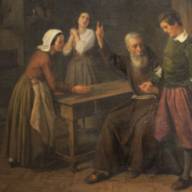
Yet another important example of the father's dominance over the whole family was his behaviour at table, indeed the very act of eating. The father, as a moral authority, did not consistently keep to his own judgements and rules. Thus the father would say of the cook that she was a "cow" who ruined every dish and turned everything into "slops". The children were forbidden to speak at table. Besides that, they had to eat quickly, because the father ate quickly. At table one was only supposed to eat, and yet the father himself broke this rule and even trimmed his nails while eating. The father's unfavourable judgements about the child's small pleasures weighed on him like an unbearable burden and eventually led him to despise himself.
His father, Hermann Kafka, was born in 1852, the son of a butcher in southern Bohemia. As the fourth of six children, he had to contribute to supporting the family from an early age. After completing his military service, he married Julie Löwy and opened a shop selling knitted goods and haberdashery in Prague, which he later expanded into a wholesale business. His chief aim was always to gain and preserve a solid social position, status and wealth.
All members of the family were subordinated to Hermann Kafka's lifestyle and principles. Only Franz and Ottla could never fit into the model their father had prescribed. Franz's fear of his father is striking, and this certainly depended above all on his father's methods of upbringing. One of the father's methods in raising his son was irony, with which he would say, for instance: "That would probably be too hard for you? Of course you wouldn't have time for that?" These words were accompanied by a spiteful expression and a sneer, and the irony the father put to such effective use reflects his dominance over his son.
For the son, in his young days, the world was divided into three categories: the first was the world in which he lived as a slave, subject to the laws of his despotic father, which the father had invented solely for him. The second category was the world in which his father lived, but which was far removed from the son's world. In it, the father ran the shop and the family, occupied with ruling, issuing commands and raging over their non-fulfilment. Finally, there was also a third world, in which everyone else lived. These people were spared having to be obedient, to submit and to carry out orders, living happily and freely. The worlds are clearly demarcated, and there is no passage from one to another.
One of the consequences of the father's perpetual dissatisfaction with his unsuccessful son, who was in no way, under no circumstances, a true "Kafka son", was that the son lost the gift of speech. The constant threat, "Not a word of contradiction!", accompanied by a raised hand, led to the son answering questions in his father's presence only reluctantly, that is, stammering and faltering in speech, until in the end he fell completely silent before him.
There is another very interesting reason for this. The father, as a "true Kafka", was, among other things, very eloquent and self-confident, and bursting with health besides. He made abundant use of this eloquence in raising his children too, most often relying precisely on his rhetorical skill. Kafka cites as examples not only insults and threats but also irony, angry mockery and, finally, self-pity. Because of all this, the son ultimately lost faith in himself: "I lost the self-confidence to do anything on my own. I became inconsistent, wavering."
The older the son becomes, the more the arguments grow that the father can put forward as proof of his incompetence. He increasingly reproaches his son for living a life of "comfort and ease", but only because he, the father, works to excess. He is the one who makes it possible for his son to live in peace, warmth and abundance. With such words and claims he constantly hammers into his son's head how well God has provided for him: "By the age of seven I already had to trudge with a handcart from village to village." In other circumstances such stories could have been an excellent educational tool, "… they could have encouraged and strengthened a child". But in this family it was not so.
In the end, all these difficulties in the relationship between father and son led the son to flee from everything that reminded him of his father. He first fled the shop, because he could no longer bear to watch his father treat the staff unjustly. He called the employees his "paid enemies" and tyrannised them with abuse and arbitrariness. And yet here too the son points to his father's superiority, overshadowing everything around him. Franz thinks that by fleeing his father he will also diminish his fear of him. He therefore tries feverishly to remove himself from the sphere of his father's influence. Writing, too, was this, as he himself says: "an attempt to escape from you. Only it was concerned with you; I was, after all, only weeping there over what I could not weep out on your breast. It was a leave-taking from you, drawn out deliberately, except that, although it was you who forced it, it took the direction I determined."
After this flight from his father, there naturally followed a flight from the family and from his mother too. The mother occupied a difficult position in the family – on the one hand she loved her husband and helped him in everything, and on the other she could understand her children's fears as well. In this "game" she played the role of the "beater in the hunt". She was unconditionally devoted to her husband and did everything she could for him, so that in the end she always sided with him. And yet she also tried to protect the children from their father. Franz fully understands his mother's conduct, whether it was a matter of love for her husband or of yielding before a father who tolerated no opposition. Because of this he flees, withdraws into solitude, and through this flight of his lost his sense of family too: "I lost my mother even in childhood." In such a situation his relationships outside the family suffered as well; he frequently had to pretend, before friends and acquaintances, as well as before the women he met.
The letter also describes in more detail the position of his sisters Elli, Valli and Ottla, and their relationship to their father. Of the three, Valli found it easiest to adapt to her father, since by nature she closely resembled her mother. Ottla, on the other hand, waged a lifelong struggle with their powerful father, just as her brother did. Elli, in essence, was very like her brother; he describes her as greedy, mean, lazy, sluggish, and so on, but she left the parental home early, married and had children. After that she changed considerably, and suddenly became a happier and quite different person. Franz had a similar idea for himself, but did not succeed in it: "Between the two of us there was no real fight. I was quickly finished off, and all that remained to me was flight, grief, inner struggle." His father did not see it that way, nor was he capable of seeing his son's inner struggle. The father said of himself that he had worked hard and sacrificed everything for his children, especially for Franz, who could therefore live as "a gentleman, free, to study whatever he wished". The father viewed things in a materialistic way, and this is in fact the main criticism the son levels at his father: "I (unlike my father), for as long as I can remember thinking at all, was so deeply concerned with the spiritual affirmation of existence that everything else was a matter of indifference to me."
An important subject of dispute between father and son was religion. The father was not a particularly devout Jew, but on the great feast days he took his son to the synagogue. He hoped that in this way he would pass on to his son something of the religious feelings he himself had acquired in childhood. However, this hope came to nothing, since these feelings naturally did not have the same sentimental value for the son as they had for the father. Precisely for this reason, the two of them could not draw closer to each other in this respect either. And when the son, of his own will, began to occupy himself with Judaism, disputes arose between them once again, because the father held the view that the only true Judaism was the one he himself had tried to pass on to his son while the boy was still a child: "I found just as little salvation from you in Judaism. Partly this was because of insurmountable impressions from my childhood, partly because of your own being, of which I was afraid."
As for the choice of profession, the father gave his son complete freedom. The son was not a good pupil and eventually studied law (after chemistry and German). This course of study suited him, and he even finished it: " You certainly gave me complete freedom, in your generous, and in this case even patient, way. There was, finally, also a certain delusion of yours about me at play here. Out of your fatherly pride, out of a failure to recognise my true nature, and also from the conclusions you drew from my physical weakness, you always believed that I was, somehow, hard-working. As a child, in your view, I was eternally studying and afterwards eternally writing something. But that is not at all correct. It would be truer, with far less exaggeration, to say that I studied little and learned nothing; a little of it has been preserved over many years thanks to an average memory and a power of comprehension that is not exactly the weakest, which is no great wonder, but in any case the overall result, in terms of knowledge and, above all, the thoroughness of that knowledge, is extremely poor, given the expenditure of time and money in the midst of an utterly carefree and peaceful life, particularly by comparison with almost everyone I know. Where I lived, I was rejected, condemned, crushed, and I was powerfully drawn by the desire to escape somewhere, but that was no job at all; it was a matter of something impossible, to which I was not equal, apart from a few small exceptions. It was in this condition, then, that I was given freedom in the choice of a profession. But was I even still capable of making use of that freedom? Did I, in fact, still trust myself enough to be able to acquire any real profession? My judgement of myself depended far more on you than on anything else, say some outward success. That was a momentary encouragement, nothing more, but on the other hand your weight always pulled far more strongly downward. For me, then, there was no real freedom in the choice of a profession, for I knew: as far as the main thing was concerned, it would all be just as completely indifferent to me as every subject at school; I therefore had to choose a profession that would allow me this indifference without wounding my vanity too much. And so the study of law suggested itself of its own accord."
The son could not imagine marrying, because he had not "shown any foresight as to the meaning and possibilities of marriage", which is probably why both his first and second attempts at marriage failed. The father placed these failed attempts in the same category as his other failures in life. And when the son resolved to marry a young girl from Prague, the father opposed this intention of his with these words: "She has probably put on some fetching blouse, the way Prague Jewish girls know how, and so you've resolved to marry her. And as soon as possible, if you can, within a week, tomorrow even, today." And then the father reached once again for his favourite tool – irony – to try to soften his son up. The basic idea behind his attempts at marriage was to found a home and become independent. Marriage was his greatest ideal: "To marry, to found a family, to accept all the children that come, to keep them safe in this insecure world and even to guide them a little further, is, in my opinion, the utmost that a person can ever achieve. Marriage is, admittedly, the greatest thing, and confers the most honourable independence, but at the same time it stands in the closest possible connection with you." To marry meant to become equal to the father precisely at the point where he was most powerful. And in this attempt too he sees himself as the guilty party: "Neither of the girls disappointed me; I disappointed them both."
He considered marriage the most beautiful thing a person could achieve in life: " In your marriage I had before my eyes, in many respects, a model marriage, exemplary in fidelity, mutual help, and the number of children, and even when the children had already grown up and increasingly disturbed your peace, the marriage as such remained untouched. It was precisely on that example that I built my own exalted conception of marriage, and the fact that my wish for marriage remained unfulfilled had quite different causes. They lay hidden in your relationship to your children, which is what this whole letter is mainly about." He held the view that marriage simply happens to many people, that they go through with it mechanically. He thought that by marrying he would establish better relations with his father, that a certain equality would arise between them once both were married. But this could only have happened if everything that had gone before between them had not taken place. What most prevented the son from entering into marriage was his fear for his existence as a writer, and his general view of marriage as a kind of danger. Besides, as a husband and father of a family, he would have had to acquire all those qualities that adorned his father, and which he himself did not possess. And these qualities would have been indispensable for supporting and providing for a family.
This letter is filled with feelings that had built up over the course of a lifetime (the author died five years later). Letter to His Father is certainly the biographical document that most clearly and most fully reveals Franz Kafka's life situation, his view of himself, and his relationship to his father. One might say that his father's influence on Kafka's life was decisive, and that the relationship between father and son is mirrored throughout his entire body of work.
At the end of his Letter to His Father Kafka gives the last word to his father, who accuses his son of being incapable of life: "You are incapable of living; but in order to be able to live comfortably, without self-reproach, in your incapacity, you set out to prove that I had taken away your capacity for life and put it in my own pocket."
- Mladen Klanac
- Hits: 55