


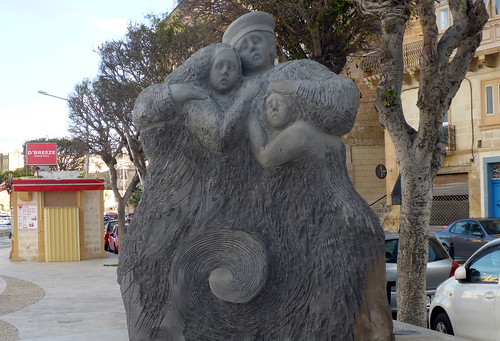
Senglea, Malta: A Sailor's Farewell to His Family
This monument is dedicated to the sailors of Senglea, Malta, and their families, and it can be dedicated to all families who have experienced separation. The sculpture is a symbol of family suffering and togetherness, of the experience of separation, but also of the longing for reunion.
It is the moment when he must part from his loved ones and say goodbye. When he returns, they will recognise one another even though changed, and will go on being together as before, but now with one new experience.
The artist who created the monument is Cari Privitera of Catania (born 1971). The monument is made from a block of lava, formed by an eruption of Etna around 1700, and cut in a quarry at Paternò near Catania in Sicily. It originally weighed 20 tonnes. The artist used a special diamond tool to carve this monument, since lava is among the hardest stones found in nature and is therefore difficult to work.
It can be compared to a family which, despite suffering and physical separation, remains firm and united. This strength is also expressed in its mass (9.5 tonnes), its volume and its proportions (1.5 m wide and 2.30 m high). It is also powerful in its dynamism. Although it seems to be at rest, it is at the same time in motion, as the figures are fused together and bound as though in a knot.
We see a mother and son embracing the father before he sets sail. It is as though they are seeking his blessing and protection, the three of them united as one body. The father embraces both his wife and his son. His hand rests on his son's head as a sign of care, blessing and protection. He has tilted his head towards his wife, expressing his love for her, while his face shows immense suffering. The wife has placed her hand on her husband's heart, as a sign of love and unity. Her embrace is deeply moving as she holds her husband. Beneath them are powerful waves that seem as though they might strike them at any moment. The son seeks protection from his father, but at the same time he is turned towards his mother; he will stay with her, and so will, in part, take on his father's role, though with a certain question on his face as to whether he will be able to. This embrace is truly something powerful, spontaneous and natural. At its core, an embrace is no different from any other activity of life, of greater or lesser significance. In a way, it sums them all up within itself. To live fully means to surrender oneself completely to someone we care about deeply. At the same time, it also means surrendering to everything that means life to us: work, conversation with friends, raising children, listening to music, painting, helping others, or anything else through which we feel that we are living and creating. This mutual interpenetration either exists or it does not. If it does not, it can begin - especially in critical and difficult circumstances of life, such as this one.
The waves are beneath the sailor, as though they could swallow him up, but also engulf the whole family. The faces, which are universal, symbolise the family of the whole of humanity; they are full of suffering and uncertainty, and so awaken instant compassion in the viewer. It is as if the question of whether they will see one another again hangs in the air. The embrace rises above the waves, as though saying - yes, the embrace and the bond are stronger than the waves.
The work is, in fact, a single unified figure, just as a family is, with no great gap between the figures. This approach increases that unity and gives the stone and the figures greater strength. This, in turn, also emphasises the strength of the family. The movement of the wave underlines the dynamism both of the individual figures and of the whole family. It carries within itself something powerful, enduring, firm - just like the lava itself. On the other hand, it brings something new, unpredictable and challenging each day.
- Mladen Klanac
- Hits: 53